Sunday, 11 January 2015

If I Were a Team UniSA-Australia 2015 Selector....


Well, the Road Nationals have been completed for another year. And I couldn't be happier about the results. Steele von Hoff, Peta Mullens, Heinrich Haussler; they are all extremely nice people whose road careers have had their setbacks. The green and gold jerseys are a wonderful result for all of them, and hopefully will lead to greater opportunities on the road.
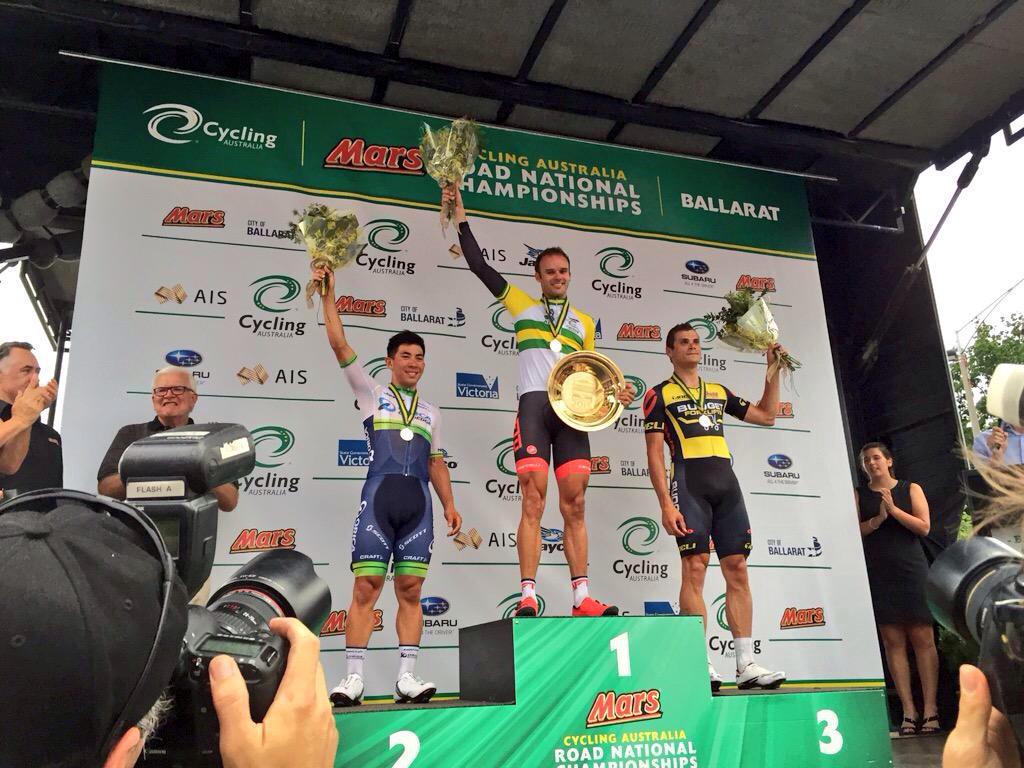
 
Steele von Hoff atop the Criterium National Championships podium
Image: https://pbs.twimg.com/media/B6vXX5GCMAAyHpr.jpg:large
 
The attention of the Australian cycling fan now turns to the Tour Down Under though. One of the biggest questions for me is the composition of the UniSA-Australia team. Previous riders have included Allan Davis, Michael Rogers, Pat Jonker, and more recently, Rohan Dennis and Caleb Ewan. The opportunities are there for riders to get results and be noticed. The team is usually geared towards young riders gaining exposure to the WorldTour level, but in the case of Davis in 2008 (who finished second overall after entering the last stage looking for time bonuses), also for a rider without a WorldTour ride to remind everyone that they can contend at the highest level. So, who would I select, and why?
 
First name on my team list is Steele von Hoff. Fresh from winning the national criterium championship, and riding this year for British squad NFTO; this is a guy who can handle his bike, beat riders in form in a power sprint, and hold his own on short climbs (having led the bunch home in the road race). Plus, there is the added value of WorldTour experience (the Garmin set-up), which means that he can hold his own against the top guys, and will probably help the younger guys on their learning curve.
 
The second thing I would do would be to call Jack Bobridge and offer him a ride. He may turn it down due to his impending Hour Record attempt and any preparation specific to that; but I would make the call nonetheless. Bobridge is another rider in form, who finished third in the time trial at Nationals, and was a big player in the road race; also with WorldTour experience. Added to all of that, he will gain phenomenal support from the home crowd, and would most likely love racing in his home city again.
 
Those are my two big names, and I'll leave space for 5 National Road Series riders. First of them is definitely Jack Haig. The Victorian has signed a pre-contract with Orica-Greenedge, and will join them in 2016. As the defending Young Rider classification winner from 2014, he should warrant selection on that basis alone. Added to that though, Haig has plenty of results at NRS level, and despite not placing highly, rode well as a marked man in the national Under-23 road race. A good climber and (judging by his 2014 TDU result) a savvy tactician, he has to be a good chance to repeat his Young Rider victory.
 
Neil van der Ploeg is another name that was on the UniSA roster last year, and I would invite him back this year. A good lead-out man or a good sprinter in his own right, as third in the national road race indicates. Van der Ploeg didn't pick up a result at the TDU last year, but with a year's extra experience and coming into form nicely, I would certainly include him in my team.
 
Next on my team sheet would be Miles Scotson, based mostly on his National Championships performance. A track national and world champion, he is a rider who dominated both the road race and time trial at under-23 level last week. A strong rider, and another who will love riding in front of home crowds. I would task him with being present in breakaways, with a view to the King of the Mountains title, if such an opportunity presented itself. Otherwise, his week would be comparing himself  to the best, and developing as a cyclist. It would be a big step, but I believe this is a young rider who can make that jump.
 
The last two riders (tasked with attacking, attacking, and attacking some more) are Ben Hill and Cameron Bayly. These two lit up the national criterium championships with their daring breakaway that came within half a lap of succeeding. Hill attacked, Bayly bridged, and no lesser name than Michael Rogers eventually came across to help them. Hill is coming back from a doping suspension that ended in October, after a mix-up regarding a product given to him by a team-mate; and has started his return to racing very aggressively, taking two stages on his way to 8th overall at the Tour of Southland late in 2014, and being omni-present in the Bay Cycling Classic races, as well as the national criterium championship.
 
Bayly is (another!) local South Aussie who has raced at Continental level, and would relish the opportunity to ride hard against the best in the world in front of home fans. This may come as a surprise selection; because he skipped the Bay Cycling Classic and the national time trial, and didn't show himself in the national road race, and therefore hasn't been in public consciousness. However, 14th place, climbing with the Evans and Porte group - along with his attack in the crits - shows that he is a rider who is coming into form nicely, and is my dark horse to infiltrate breaks.
 
I believe this team is a combination of youth and experience, and full of riders who will be hungry to show that they can compete with the best. This group would be present in the breaks (Scotson, Hill and Bayly), contesting the sprints (van der Ploeg and von Hoff), contending the Young Rider classification (Haig, maybe Scotson), and potentially challenging for the General Classification (Bobridge). Added to their varied skills, this is a group of riders who have been both leaders and workhorses for their teams, and therefore should be happy to ride for each other, which in turn should form a happy, cohesive, aggressive and under-rated team. The epitome of the traditional character of the UniSA-Australia team.

Thursday, 4 December 2014

The Astana Inevitability


Recently, several Kazakh riders on Astana and “Astana 2” (Nibali’s words) have tested positive. Disappointing, yes. Surprising? Yes, until I thought about it.

Again, a brief (and selective) history of the last 2 decades of cycling. In July 1998, the Festina Affair caught international headlines, when team soigneur Willy Voet was caught with a supply of drugs plentiful enough to dope each rider several times over, for each day of the Tour de France. The French criminalized performance enhancing drug (PED) taking, and we’ve heard only scattered and isolated doping cases out of France since (the highest-profile case I can recall recently was Yoann Offredo, who forgot to fill in his whereabouts forms). 2006 marked the next big scandal, with Operacion Puerto in Spain. Next up is 2007, and the Michael Rasmussen and Rabobank saga, which took until 2010 to fully eke out. Then, in 2008, Schumacher, Kohl and Rebellin from the German Gerolsteiner team were found to have EPO-CERA in their systems. 2012 was the year that the Russian Katusha team were denied a WorldTour place on “ethical” grounds. One feels that Denis Galimzyanov’s positive certainly had an impact on this. In May 2013, the Italian team Vini Fantini had two positives and were excluded from the Giro. However, as in incredibly general rule, we've heard fewer and fewer positives coming from these countries after these incidents.

Richard Virenque is among the Festina riders answering tricky questions in 1998
Image: http://i.telegraph.co.uk/multimedia/archive/01465/Richard_Virenque_1465136i.jpg

So, viewing these incidents in a geographic sense of the continental mainland; I've ordered them as starting in France, in the West of Europe, heading to Spain, Denmark and Holland, Germany, Russia, and Italy. In other words, the doping scandals are heading east. The next major stop in cycling on that tour was going to be Kazakhstan. Hopefully, this Astana affair will draw a line under Kazakh riders, and this will be the last doping controversy that we hear from them.

Maxim Iglinskiy winning Liege-Bastogne-Liege
Image: http://cdn.mos.bikeradar.com/images/news/2012/04/22/1335127630093-1ntsllx61u13s-700-80.jpg

Which leaves everything in a happy place, right? Erm, maybe not. If this trend continues, we still have to work through scandals in the Middle East and Asia. I hope I’m wrong, but based on an article written by Andrew Christie-Johnson last year, and a first-hand account suggest that teams can sidestep doping controls, or otherwise still manipulate them. This probably has a lot more freedom in the lower continental ranks than the elite echelon. But when the professionalism of the testers catches up with the riders, and if the market in Asia explodes with professional teams; we might not be out of the woods for doping scandals for years to come.


I just hope I’m wrong.

Why Lance is an Unlucky Loser


Several months ago, a poll was conducted of retired cyclists, which was then opened to the public on the SBS Cycling Central website. It asked whether Lance Armstrong should keep his titles from the Tour de France. Reading some of the comments led me to put my own thoughts out on the matter; in a more constructed way than a short rant on a comment thread, and in such a way that might help others to resolve any internal conflict.

Firstly (and bear with me here…), a short history of the Tour is important to put the events of the past 20 years into perspective. The Tour started in 1903, as a race that was barely more structured than designating start and end points, in cities several hundred kilometres away from each other. In the second edition, unsurprisingly for a race as unstructured as it appeared to be; several riders caught the train or travelled in a car. Six months later (apparently the wheels of justice still turned as quickly then as now) the first four riders were disqualified. The race survived the too-partisan fans disrupting riders and the disqualifications, and continued for a third year. Shortly afterwards, the publicity caravan was invented, mountains were added, trade teams took over from national teams, national teams took over from trade teams, Tom Simpson died in 1967, trade teams came back, the Champs Elysees became the finishing point; and the Tour as we know it now continued to grow and develop into the spectacle and the brand that it is today.

However, in 2007, when Floyd Landis was denying his wrongdoing from 2006, Vinokourov tested positive and Rasmussen was booted, the public and peloton could barely believe what was unfolding in one of the sport’s darkest moments. I believe that Landis (from 2006, 102 years and 90-or-so Tours later) was the first rider since Maurice Garin in 1904 to have his title taken away from him. Since that day in late 2007 when it was announced officially, Alberto Contador (2010) and Lance Armstrong (1999 – 2005) have also had their titles annulled. Which means that for the last 16 final presentations, only 7 were for the rider who is still considered to be the Tour winner.

Floyd Landis atop the Champs Elysees podium, July 2006
Image credit: http://www.smh.com.au/ffximage/2006/07/24/tourfloydlandis_gallery__428x400,0.jpg


If we look back through the history of the sport, I believe that Pantani (who died of a drug overdose at the height of the doping war), Riis (admitted), Ullrich (on Riis’ T-Mobile team and with a dubious record), Coppi (who practically admitted to taking amphetamines), Anquetil (who did admit to taking amphetamines), Pelissier (who showed a journalist some pills mid-race), Merckx (probably, he did fail a drug test, admittedly with a significant grey area), among many others, may have won the Tour de France while chemically or medically assisted. That is a thoroughly non-exhaustive list, and I apologise that I have singled out certain riders. But I have listed at least 16 Tour wins, potentially achieved on drugs. Stripping names like Coppi, Anquetil or Merckx from the winners list, or investigating everyone else who has won the Tour is to my mind a waste of time, and is seriously degrading to the sport I love. I’m not condoning cheating, but to me, the punishments should be consistent throughout history.

My above statement about consistently punishing riders who cheat opens a can of worms though. Do we erase the majority of the Tour’s (and cycling’s) record books, while digging up oh so many skeletons? I don’t think that’s a good option for the sport. Do we reward Lance Armstrong for “the most sophisticated, professionalised and successful doping programme” the world has ever seen? Again, I don’t think that’s a good option. We, as fans, are faced with the choice that essentially boils down to the simple questions: “How OK are you with doping?” and “How long should you take to forgive and forget?” with the equally subjective question “Does sport exist for entertainment?” Or have the answers to those questions changed over time?

I’m inclined to say that the answers have changed. We’ll start with the third, and possibly easiest issue of entertainment. The stars of the past (I’ve read mostly about the 1950’s and 1960’s) earned most of their money through appearance fees at criteriums, traditionally held just after the Tour de France. Sandrino Carrea (a team-mate of Coppi) attributes the house that he bought to the single day in yellow that he earnt. This is part of the prestige of stage wins or a stint in yellow at the Tour, because such a feat would get the rider’s name in the newspaper and into public consciousness. In August, the public would pay to see the big names race…for ENTERTAINMENT. The races were (and probably still are) rigged in favour of rider popularity. However, in the current climate, the appearance fees at criteriums would be simply a footnote on the earnings of a top professional, who exists to win races, in COMPETITION. All of which means that maybe the race that was started to entertain and subsequently sell newspapers, has morphed into a race which is all about results. I highly doubt that any rider has ever raced the Tour according to a publicity script, but many of the riders knew that they had to be popular in order to earn a decent living, whereas today, results dictate a rider’s value. So yes, I believe that the integrity of a clean race has increased, as the need for popularity stemming from the Tour has decreased.

Has the view on taking drugs changed over time? Again, I believe so. Cheating/doping within the peloton was far more accepted, even in the early 2000’s if David Millar’s book is to be believed. It was nearly accepted practice in the 1960’s and 1970’s if my research is correct, and testing wasn’t introduced until the late sixties. Before the Second World War, I get the impression that it was carte blanche for drugs, with no testing, no constant suspicion and no significant performance gains. Gastone Nencini (the 1960 Tour winner) was reportedly found by Dr Pierre Dumas (the Tour doctor) smoking a cigarette, with drips in his arms, mid-Tour; although in an age where blood transfusions were not banned. Eddy Merckx had a failed drugs test for a substance that was rescinded from the banned list. The penalty for failed tests has been increased. The testing has been increased, but I feel that the biggest change has been the performance advantage that can be gained. EPO supposedly adds 10% to a rider’s “engine”. Blood transfusions can add 9%. Testosterone, growth hormone, and any number of other drugs can all add up to make a difference significant enough to physically alter a human’s capacity to ride a bike quickly, as opposed to an amphetamine, which really only improves a mental state.


This has left still more questions to be answered, and I’ll leave each one to you. Personally, my answer to the “Am I OK with doping” question is not clear-cut. Where do I draw the line? Are bananas OK? Is commercially available artificial protein powder OK? Well, yes, even though both improve performances. Is a mind-altering substance OK? From a safety point of view, no. Is a 3% gain from a doping product OK? No. Is up to 15% from various drugs OK? Absolutely not. Is it OK to dope if there is no way of being caught? Well, how much does winning matter? How long is a piece of string? I can’t answer that one for you. And I certainly can’t answer how long it should take to forgive and forget any previous indiscretions concerning drug-taking in sport. But for what my opinion is worth, catching Landis, Vinokourov, and Contador with in-competition tests is enough to take results away. Taking 7 years to catch Lance, well, I’m remembering Lance’s phrase “witch-hunt.” Yes, I believe that he can feel aggrieved to have lost his Tours, but (hopefully) the late 90’s was the beginning of the end of the end for drugs dictating the results of the sport. In that sense, I’m glad that the sport has marked a turning point. For Lance, he’s unfortunate that the turning point fell in those seven years.